Kingmaker Workflow Management
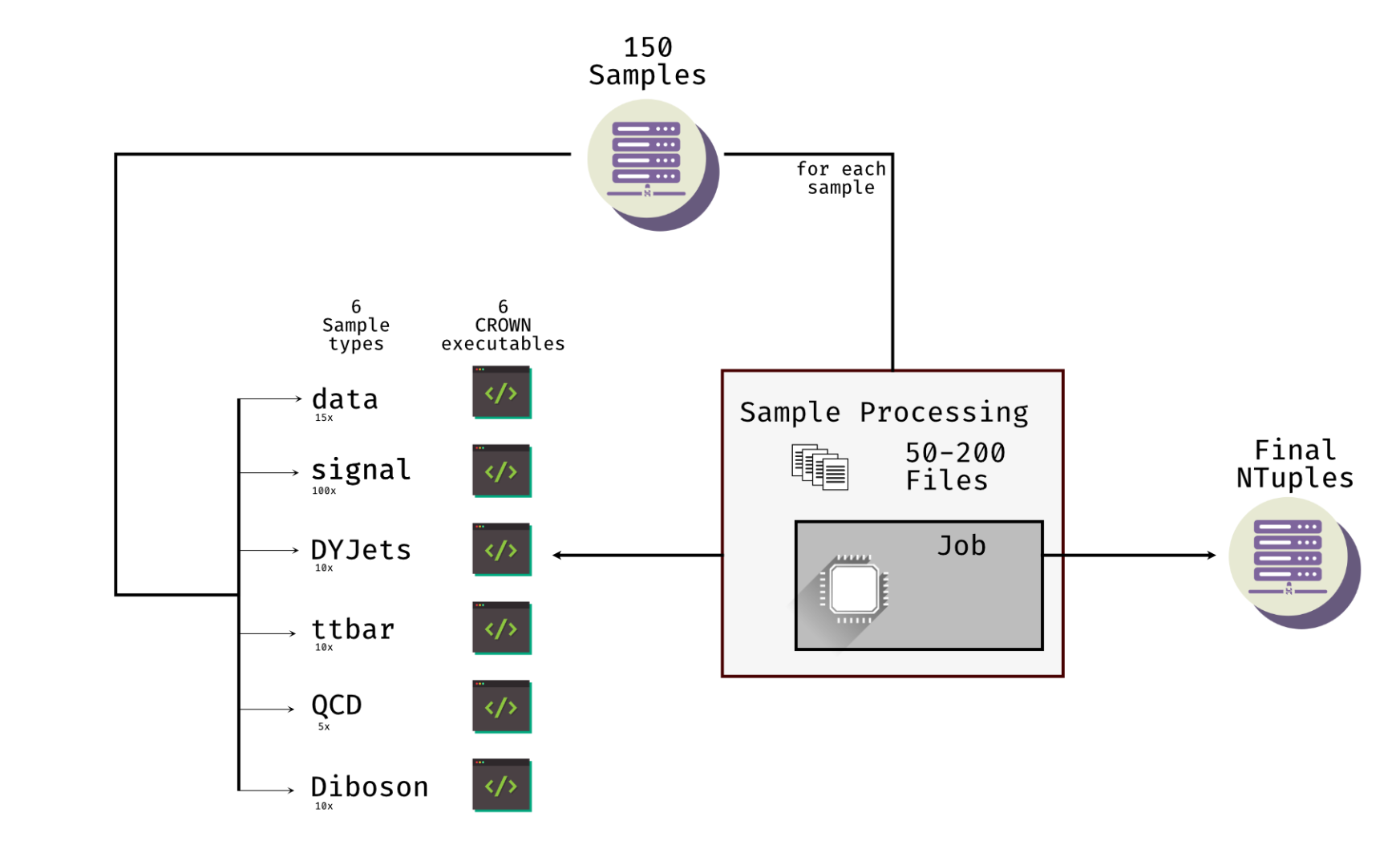
KingMaker is a workflow management for producing ntuples with the CROWN framework. The workflow management is based on law (https://github.com/riga/law), which uses luigi (https://github.com/spotify/luigi) as the backend. Kingmaker is used to orchestrate the production of ntuples and friend trees for the CROWN framework. The workflow is designed to be flexible and can be adapted to different analyses. Kingmaker takes care of building all required CROWN executables, submitting jobs to a batch system and writing the output to a remote storage. On top of that, Kingmaker can be used to generate FriendTrees, which can be used to store additional information to extend the ntuples. A sample manager is provided to manage the samples and keep track of the individual input files that have to be processed.
Setup
git clone git@github.com:KIT-CMS/KingMaker.git
cd KingMaker
source setup.sh
This installs all required packages and sets up the environment. In addition, a luigid scheduler is started, if not already running. The required port is set to the `LUIGIPORT` environment variable.
The setup script has also additional options:
Usage: source setup.sh [options]

Options:
-w, --workflow WORKFLOW     Specify the workflow to use
                            [default: KingMaker]
-a, --analysis NAME         Specify CROWN analysis to check out (only with KingMaker workflow)
                            [default: plain CROWN]
                            Available analyses: https://crown.readthedocs.io/en/latest/introduction.html#id1
-e, --env-path PATH         Specify custom environment path
                            [default: auto-detected]
-l, --list                  List available workflows
-h, --help                  Show this help message
It is possible that the session failes to connect to the remote scheduler after some time.
After source setup.sh is run, the scheduler is running on a random port, which is stored in the LUIGIPORT environment variable.
If the connection to the scheduler is lost, a new port can be set using the following command:
set_luigiport
Management of samples
Samples can be managed manually or using the sample_manager, which can be started with
sample_manager
This starts a CLI, which can be used to add more samples to the database, update samples or quickly generate a sample list for producing ntuples.
Information on CMS datasets
To search for CMS datasets, we need first a bit of information, how these datasets can look like. We refer to the CMS dataset names as DAS nicks, since we will search for them using the
Data Aggregation Service (DAS) of CMS. The datasets can be searched for at https://cmsweb.cern.ch/das/, or alternatively via dasgoclient (https://github.com/dmwm/dasgoclient) in a CMSSW
command-line environment. Our sample_manager integrates the corresponding software components and puts them into a questionnaire logic.
The naming convention of CMS datasets is according to https://twiki.cern.ch/twiki/bin/view/CMSPublic/WorkBookLocatingDataSamples as follows:
# Convention:
/PrimaryDataset/ProcessedDataset/DataTier
# Examples:
## MC Simulation:
/DYJetsToLL_M-50_TuneCP5_13TeV-madgraphMLM-pythia8/RunIISummer20UL16NanoAODv9-106X_mcRun2_asymptotic_v17-v1/NANOAODSIM
## Data:
/Tau/Run2016B-ver2_HIPM_UL2016_MiniAODv2-v1/MINIAOD
## User-produced Dataset:
/Tau/aakhmets-data_2016ULpreVFP_tau_Tau_Run2016B-ver2_HIPM_1736940678-00000000000000000000000000000000/USER
PrimaryDatasetusually represents the superset of data recorded by the experiment in case of Data, and the simulated process in case of MC simulation. In general, for User-produced Datasets this can be anything, however, it is the responsibility of the users to giving meaningful names so that other people can also use their Datasets.ProcessedDatasetprovides details on the actual production or processing campaigns of the dataset, including conditions (so-calledGlobalTag), version, etc. Again, user Datasets can state anything, but users are encouraged to set meaningful names.DataTierrepresents the dataformat of the dataset. A list of some more popular formats is given here: https://twiki.cern.ch/twiki/bin/view/CMSPublic/WorkBookDataFormats#EvenT. We are mostly interested in NANOAOD(SIM) and MINIAOD(SIM) which are tailored for analyses. TheUSERdatatier represents anything that a user can produce.
All centrally produced datasets from CMS are stored under the prod/global DAS instance, while there is a dedicated DAS instance for user datasets, prod/phys03.
See https://cmsweb.cern.ch/das/services for more details.
Chosing NanoAOD version
Before any of the option can be used, the user has to select the desired NanoAOD version from a list of available versions. The sample_manager will then use this version to query the database.
The currently available versions are:
Starting Samplemanager
? Select a nanoAOD version (Use arrow keys)
» nanoAOD_v9
nanoAOD_v12
nanoAOD_v15
Addition of new Samples
When adding a new sample, follow the instructions of the sample_manager. In the background, the DAS database of CMS is queried, to get samples, matching the provided dataset name:
Starting up Datasetmanager
A working version of the database exists
? Load working version of database ? No
Database loaded
The database contains 581 samples, split over 4 era(s) and 22 sampletype(s)
? What do you want to do? Add a new sample
? Select the DAS instance for the search prod/global
? Enter a DAS nick to add /DYJetsToLL_M-50_*/RunIISummer20UL16NanoAOD*v9-106X*/NANOAODSIM
Multiple results found
? Which dataset do you want to add ? (Use arrow keys to move, <space> to select, <a> to toggle, <i> to invert)
» ○ Nick: /DYJetsToLL_M-50_TuneCH3_13TeV-madgraphMLM-herwig7/RunIISummer20UL16NanoAODAPVv9-106X_mcRun2_asymptotic_preVFP_v11-v1/NANOAODSIM - last changed: 03 Jan 2023 11:05 - created: 30 Nov 2022 14:26
○ Nick: /DYJetsToLL_M-50_TuneCH3_13TeV-madgraphMLM-herwig7/RunIISummer20UL16NanoAODv9-106X_mcRun2_asymptotic_v17-v1/NANOAODSIM - last changed: 08 Nov 2022 13:17 - created: 08 Nov 2022 05:15
○ Nick: /DYJetsToLL_M-500to700_TuneCP5_13TeV-amcatnloFXFX-pythia8/RunIISummer20UL16NanoAODv9-106X_mcRun2_asymptotic_v17-v2/NANOAODSIM - last changed: 05 Nov 2022 22:12 - created: 04 Nov 2022 00:52
○ Nick: /DYJetsToLL_M-500to700_TuneCP5_13TeV-amcatnloFXFX-pythia8/RunIISummer20UL16NanoAODAPVv9-106X_mcRun2_asymptotic_preVFP_v11-v1/NANOAODSIM - last changed: 15 Sep 2022 00:09 - created: 14 Sep 2022 22:32
○ Nick: /DYJetsToLL_M-50_Zpt-100to200_BPSFilter_TuneCP5_13TeV-madgraphMLM-pythia8/RunIISummer20UL16NanoAODAPVv9-106X_mcRun2_asymptotic_preVFP_v11-v1/NANOAODSIM - last changed: 05 May 2022 07:44 - created: 26 Apr 2022 06:
○ Nick: /DYJetsToLL_M-50_Zpt-100to200_BPSFilter_TuneCP5_13TeV-madgraphMLM-pythia8/RunIISummer20UL16NanoAODv9-106X_mcRun2_asymptotic_v17-v1/NANOAODSIM - last changed: 28 Mar 2022 21:51 - created: 28 Mar 2022 19:42
○ Nick: /DYJetsToLL_M-50_TuneCP5_13TeV-madgraphMLM-pythia8/RunIISummer20UL16NanoAODv9-106X_mcRun2_asymptotic_v17-v1/NANOAODSIM - last changed: 20 Feb 2022 06:54 - created: 17 Feb 2022 22:29
○ Nick: /DYJetsToLL_M-50_TuneCP5_13TeV-amcatnloFXFX-pythia8/RunIISummer20UL16NanoAODv9-106X_mcRun2_asymptotic_v17-v1/NANOAODSIM - last changed: 29 Nov 2021 11:10 - created: 28 Nov 2021 07:54
The results will be sorted by time, starting with the newest samples on top. The query name has to match the CMS conventions /*/*/*. Select all samples that you want to add. Afterwards, set the correct sample type. Optionally, the sample_manager can calculate the GeneratorWeight associated to the sample. Since this process can take some time, the task can also be triggered afterwards.
Generation of sample lists
To generate a sample list select Create a production file
The database contains 581 samples, split over 4 era(s) and 22 sampletype(s)
? What do you want to do? (Use arrow keys)
    ○ Add a new sample
    ○ Edit a sample (not implemented yet)
    ○ Delete a sample
    ○ Find samples (by nick)
    ○ Find samples (by DAS name)
    ○ Print details of a sample
    » ○ Create a production file
    ○ Update genweight
    ○ Save and Exit
    ○ Exit without Save
    Answer: Create a production file
In the next step, select the eras you want to process using the arrow keys and space bar
Select eras to be added  (Use arrow keys to move, <space> to select, <a> to toggle, <i> to invert)
○ 2016postVFP
○ 2016preVFP
● 2018
» ● 2017
and then select the sample types you want to process. The output file will be a .txt file, which can be used to produce ntuples.
Submission of ntuples
In Kingmaker, there are three variants:
The production of ntuples
The production of friend trees
The production of multiple friend trees (friend trees that depend on other friend trees)
All variants are handled by the same ProduceNtuples task. Which variant is run depends on the provided parameters. In the case of friend trees, missing Ntuples or other friend trees are generated automatically.
Warning
By default, KingMaker will write all outputs to the GridKA NRG storage. As a result, the user has to provide a valid X509 proxy, and the environment variable X509_USER_PROXY has to be set. The proxy can be created using voms-proxy-init. The proxy has to be valid for at least 24 hours. The proxy can be checked using voms-proxy-info.
To use a different output storage, the KingMaker configuration has to be adapted, more details can be found in the KingMaker Configuration section.
Production of NTuples
To trigger a production of ntuples run
law run ProduceNtuples --analysis template_analysis --config template_config --production-tag test_production_v1 --sample-list samples.txt --nanoAOD-version nanoAOD_v9 --scopes mm --shifts None --workers 8
The different options are:
--analysis: The analysis to be used. The name corresponds to the analysis folder in theCROWN/analysis_configurationsfolder.--config: The config file to be used. The config file contains the information about all producers, parameters and output branches that are needed to run the ntuple production of your analysis. The config file is located in theCROWN/analysis_configurations/<analysis>/folder.--production-tag: The production tag is used to identify the production (default:default/<timestamp>). It is used to create the output folder and the output files. The output files are stored in the/<base>/<production-tag>/CROWNRun/folder. Thebasevariable is set using the Configuration. By default, it is set toroot://cmsdcache-kit-disk.gridka.de//store/user/${USER}/CROWN/ntuples/. Within theCROWNRunfolder, the different samples are stored, matching the<era>/<samplenick>/<channel>/<samplenick>_<counter>.rootpattern.--sample-list: The sample list to be used. The sample list can be generated by thesample_managerand contains the information about the samples to be processed. The sample nicks can also be provided as a comma-separated list.--nanoAOD-version: The NanoAOD version to be used. This should usually be the same version that was selected in thesample_managerstep. (default:nanoAOD_v15)--scopes: The scopes to be used, provided as a comma-separated list (default:mt,et).--shifts: The shifts to be used, provided as a comma-separated list (default:None). If this parameter is not set, no shifts are applied. IfAllis provided, all shifts are applied, ifNoneis provided, no shifts are applied.--workers: The number of workers to be used (default:1). Each worker is responsible for the submission and handling of one sample. The number of workers should be at least the number of samples. If it is lower only the given number of samples will be processed at the same time and the additional samples will only be submitted when one of the already submitted samples is finished.
Warning
The law processes can get stuck after building the tarball when trying to upload it to the dCache when using more than 1 worker. The task will be stuck indefinitely. To avoid this, the user must cancel the running law command using Ctrl+C. Afterwards, the task can be restarted using the same command. The task will then continue with the upload of the tarball. The reason for this behaviour is unknown.
Additionally, the following options can be useful:
--print-status -1: Print the status of the tasks. If-1is provided, the status of every task is printed.--remove-output -1: Remove the output files. This option is useful if the production fails and the output files should be removed. This will trigger an interactive CLI, where only parts of the production can be removed as well.--CROWNRun-workflow local: This option can be used to run the production locally. This is useful for debugging purposes if the batch system is currently not available. However, be aware, that this option should only run with a limited amount of workers and samples since it is very easy to overload the local machine.
Warning
When using the dCache as Ntuple storage, the remove option should be used with care. Since the dCache caches files without checking, if the file content changes, overwriting files can lead to errors, where the old file is still cached. The saver option is to remove the old files and store the new files using a separate production-tag.
Production of friend trees
For the production of friend trees, the same options as for the production of ntuples are available. An example command is given below:
law run ProduceNtuples --analysis template_analysis --config template_config --production-tag test_production_v1 --friend-config template_friend_config --friend-tag test_friend_v1 --sample-list samples.txt --nanoAOD-version nanoAOD_v9 --scopes mm --shifts None --workers 8
Some additional options are required:
--friend-config: The friend config file to be used. The friend config file contains the information about the friend trees to be produced like the producers to be run and the output branches that should be saved to the friend trees. The friend config file needs to be located in theCROWN/analysis_configurations/<analysis>/folder.--friend-tag: The tag of the friend tree to be produced. The tag can be different from the friend config file name and identifies a friend tree production. The resulting friend trees will be stored in the/<base>/<production-tag>/CROWNFriend/<friend-tag>/folder.
The resulting folder structure for the command listed above will be
/<base>/<production-tag>/
    |- CROWNRun/
                    |- <era>/<samplenick>/<channel>/<samplenick>_<counter>.root
    |- CROWNFriend/
                    |- test_friend_v1/<era>/<samplenick>/<channel>/<samplenick>_<counter>.root
To perform the generation of friend trees locally, use
-- CROWNFriend-workflow local: This option can be used to run the production locally. This is useful for debugging purposes if the batch system is currently not available. However, be aware, that this option should only run with a limited amount of workers and samples since it is very easy to overload the local machine.
Production of friend trees with additional friends as input
If the requested friend tree depends on additional friend trees the --friend-mapping` parameter is used to specify the friends required for the new friend configuration. The command
law run ProduceNtuples --analysis template_analysis --config template_config --production-tag test_production_v1 --friend-config template_multifriend_config --friend-tag test_multifriend_v1 --friend-mapping '{"template_multifriend_config":{"friend_tag":"test_multifriend_v1","requires":["template_friend_config"]},"template_friend_config":{"friend_tag":"test_friend_v1"}}' --sample-list samples.txt --nanoAOD-version nanoAOD_v9 --scopes mm --shifts None --workers 8
contains an additional option --friend-mapping: A dictionary of friend configurations and their required friends with an optional friend_tag for the required friend tree. This mapping can also be provided in the form of a yaml file like the example processor/tasks/minimal_multifriend_map_example.yaml. If the required friend trees are already produced, their production will be skipped. If the dictionary is provided via the comand line, it has to be provided as a JSON string. An example is given below:
--friend-mapping '{"template_multifriend_config":{"friend_tag":"test_multifriend_v1","requires":["template_friend_config"]},"template_friend_config":{"friend_tag":"test_friend_v1"}}'
As an example, the command listed above will produce not only ntuples for all samples specified in samples.txt using the template_config but also the friend tree test_friend_v1 based on the template_friend_config. Both inputs will then be used, to produce the final friend tree test_multifriend_v1 based on the template_multifriend_config. The resulting folder structure will be
/<base>/<production-tag>/
    |- CROWNRun/
                    |- <era>/<samplenick>/<channel>/<samplenick>_<counter>.root
    |-  CROWNFriend/
                    |- test_friend_v1/<era>/<samplenick>/<channel>/<samplenick>_<counter>.root
                    |- test_multifriend_v1/<era>/<samplenick>/<channel>/<samplenick>_<counter>.root
with the example friend_mapping mentioned above. The config file name is used as the friend tag if no friend_tag is provided for a friend in the mapping or the command line arguments. If a friend config is required by a selected friend config, but not mentioned in the mapping, then the required config is added without requirements and with the default tag.
As long as the provided yaml file or dict string to –friend-mapping contains all required information like the friend tag and friend requirements, the options –friend-config and –friend-tag don’t need to be specified. An example of such a yaml file is e.g. processor/tasks/multifriend_map_example.yaml. This can also be used for normal friend production without additional friend requirements.
KingMaker Configuration
The two relevant configuration files can be found in the lawluigi_configs folder. They are called KingMaker_law.cfg and KingMaker_luigi.cfg.
Warning
Most default parameters in the Configuration are chosen such that only minimal changes are required. Nevertheless, the user should check the configuration files before running KingMaker.
In the KingMaker_law.cfg file, the different tasks are defined. Also, the remote filesystem is defined here:
[wlcg_fs]
base: root://cmsdcache-kit-disk.gridka.de//store/user/${USER}/CROWN/ntuples/
use_cache: True
cache_root: /tmp/${USER}/
cache_max_size: 20000
In general, it is good practice to use the use_cache option. This will cache the files locally, which can speed up the processing. The cache_max_size option defines the maximum size of the cache in MB. If the cache is full, the oldest files are removed from the cache.
The base option defines the base path of the remote filesystem. The ${USER} variable is replaced by the username. The base path is used to define the output path of the ntuples and friend trees. The base path is also used to define the input path of the friend trees. The base path should be set to the path of the dCache storage.
The KingMaker_luigi.cfg file contains the configuration of the different tasks. The most important options are defined in the [DEFAULT] section and include setting for the HTCondor job submission. Parameters defined in the [DEFAULT] section can be overwritten in the task-specific sections.
name = KingMaker
ENV_NAME = KingMaker
wlcg_path = root://cmsdcache-kit-disk.gridka.de//store/user/${USER}/CROWN/ntuples/
htcondor_accounting_group = cms.higgs
htcondor_remote_job = True
htcondor_universe = container
transfer_logs = True
local_scheduler = True
tolerance = 0.00
acceptance = 1.00
; submit only missing htcondor workflow branches (should always be true)
only_missing = True

; bootstrap file to be sourced at beginning of htcondor jobs (relative PATH to framework.py)
bootstrap_file = setup_law_remote.sh
files_per_task = 10
; scopes and shifts are to be provided in the config, or as command line arguments via --scope and --shift
; in both cases, the values are expected to be comma-separated lists without spaces or quotes
scopes = mt,et
shifts = None
Here, the wlcg_path option should be set to the same path, as the base path in the KingMaker_law.cfg.
The different htcondor_ parameters have to be adopted according to the requirements of the batch system.
For the different tasks, that are run remotely, different job requirements can be set.
The files_per_task option defines the number of files to be processed per task.
The number of files per task can also be customly set to a specific sample type via the custom_files_per_task option.
This will overwrite the default value set by files_per_task for the specified sample type, e.g. custom_files_per_task = {"ttbar": 3, "wjets": 20}.
The sample types are defined in the [KingMaker database](https://github.com/KIT-CMS/KingMaker_sample_database).
The scopes and shifts options define the scopes and shifts to be used.
These two parameters can also be provided as command line arguments, which is the recommended way.
Here CROWNRun and CROWNFriends as an example:
[CROWNRun]
; HTCondor
htcondor_walltime = 10800
htcondor_request_memory = 16000
htcondor_request_disk = 20000000
htcondor_request_cpus = 4
# for these eras, only one file per task is processed
problematic_eras = ["2018B", "2017C", "2016B-ver2"]

[ CROWNFriend]
; HTCondor
htcondor_walltime = 10800
htcondor_request_memory = 16000
htcondor_request_disk = 20000000
# friends have to be run in single core mode to ensure a correct order of the tree entries
htcondor_request_cpus = 1
The problematic_eras option is used to define eras, where only one file per task is processed. This can be required, if the NanoAOD input files have a change in their structure, e.g. if trigger paths are modified. To avoid problems in these cases, jobs can be processed with only one input file. This will slow down the processing but ensures that the processing is not stopped by a single file. Disk, wall time and other requirements can be set in the task-specific sections.
Warning
For friend trees, multiprocessing is not possible, since the resulting friend tree must have the same order as the input tree. Therefore, the htcondor_request_cpus option has to be set to 1, which will disable multiprocessing.
For a more complete description of the different options, please refer to the overcomplete configuration in the law repository (https://github.com/riga/law/blob/master/law.cfg.example).
A KingMaker specific option is force_repack_tarball. If this option is set to True, the tarball will be repacked and reuploaded to the remote storage, even if it already exists.
This can be useful, if inbetween running workflow steps the KingMaker code significantly changes.
Since the tarball with the workflow code is built at the beginning of the first workflow run and then reused for the following workflow runs, changes are not automatically propagated to the remote tarball.
The default is False since such changes are not common.
An important configuration option that can be defined is [logging].
Here, the logging level can be set, which is useful for debugging purposes.
The default is INFO, which provides a good balance between verbosity and information.
For debugging purposes, it can be set to DEBUG, which will provide more detailed information about the workflow execution.
For example:
[logging]
law: DEBUG
luigi-interface: DEBUG
gfal2: DEBUG
xrootd.stat: DEBUG
KingMaker Installation in lxplus
KingMaker and CROWN can be installed in lxplus, and it is recommended to do so under the user’s /eos space, since CROWN tarballs can get heavy.
Because of that, eos job submission only is supported. The setup and configuration is auto-detected and unchanged from previous instructions.
One thing to note is that to run condor_q from a new shell and see the current jobs (on the same or different machine), you need to first source the KingMaker setup, as this will
resolve the particular scheduler used for submission. Otherwise you can run condor_q -global to see all of them at the same time.
Local debugging
The compiled executables that are used in the submitted jobs can be found in the tarballs/<production_tag>/ directories.
All executables can be tested locally:
Run the
CROWN/init.shscript, which puts you into the container environment.Change to the directory with the executable (tarballs/<production_tag>/CROWN*/, depending on which step you are running).
Run the executable with the required arguments.
- The exact arguments required to call the executable depend on the type:
For Ntuples, provide an output file name and the NanoAOD file(s).
For Friends, provide an output file name and the CROWN-Ntuple file.
For Friends with additional friend inputs, provide an output file name, the CROWN-Ntuple file and the additional friend file(s).
Ntuples, as well as produced Friends, are stored in remote storage by default. The executables work with remote input paths/files, but the path to the output file should be local.
# Ntuples
cd tarballs/<production_tag>/CROWN_<analysis_name>_<config_name>/
./<config_name>_<data_type>_<era> <output_file> <input_file1> <input_file2> ...

# Friends
cd tarballs/<production_tag>/ CROWNFriend_<analysis_name>_<friend_config_name>_<mapped_friend_tag>_<sample_type>_<era>
# Where `mapped_friend_tag` is either directly set via `--friend-tag`, or set in the `--friend-mapping` for the `friend_config`.
./<friend_config_name>_<data_type>_<era>_<scope> <output_file> <Ntuple_file>


# MultiFriends (Friends with Friends as inputs)
cd tarballs/<production_tag>/ CROWNFriend_<analysis_name>_<multifriend_config_name>_<multi_friend_tag>_<sample_type>_<era>
# Where `multi_friend_tag` is set via `--friend-tag`.
./<multifriend_config_name>_<data_type>_<era>_<scope> <output_file> <Ntuple_file> <Friend_file1> <Friend_file2> ...
For the command provided in Production of friend trees with additional friends as input, this turns into:
# Ntuples
cd tarballs/test_production_v1/CROWN_template_analysis_template_config/
./template_config_data_2018 <Ntuple_file> <input_file1> <input_file2> ...

# Friends
cd tarballs/test_production_v1/ CROWNFriend_template_analysis_template_friend_config_test_friend_v1_data_2018/
./template_friend_config_data_2018_mm <Friend_file> <Ntuple_file>

# MultiFriends (Friends with Friends as inputs)
cd tarballs/test_production_v1/ CROWNFriend_template_analysis_template_multifriend_config_test_multifriend_v1_data_2018/
./template_multifriend_config_data_2018_mm <MultiFriend_file> <Ntuple_file> <Friend_file>
If further investigation is needed, a local compilation of the CROWN config is recommended as described in Running the framework with optionally activating -DDEBUG.